
Imagine learning to knit, but never how to start. My life has been a series of stitches, some held tight, others unraveled. Little did I know, those stitches would become a way to connect with and support our learners.
Born in Kenya, of Pakistani heritage, and raised as a third culture kid, my childhood was a tapestry of diverse experiences. My older brothers and working parents meant I often found comfort with my nanny. It was she who first introduced me to the world of yarn, teaching me to knit—but, crucially, not how to cast on. That incomplete skill led to a disheartening moment at summer camp when a counselor, faced with my yarn-startless project, simply unraveled it all. That was the end of my first foray into crafting.
Later, as I grew older, my wonderful aunts attempted to teach me sewing and embroidery. But being left-handed in a right-handed world presented its own set of challenges. It felt like I was always working against the grain.
Then, during a winter break in college, while staying with my uncle’s family, I found myself with time and a need for a creative outlet. A trip to Walmart led me to a crochet guide and some yarn. Unsure if I could succeed, I dove in. Through sheer determination and persistence, I taught myself to crochet. My first project? A “belt,” according to my uncle. That “belt” grew into a blanket, a tangible symbol of my newfound skill.
That blanket became a cherished companion, traveling with me from college back to Kenya, and then to the UK as I pursued my teaching education. It was a piece of home in a world of constant change. However, when my family and I embarked on our overseas teaching journey to Mozambique, not everything could make the cut. The blanket, along with many cherished teaching resources, had to be left behind.
Eight years in Mozambique brought new experiences and a growing collection of handmade crochet blankets. But when we moved to Dushanbe, Tajikistan, the cost of shipping was prohibitive. We left with eight suitcases, leaving behind a wealth of possessions. As I transitioned into teaching in this new environment, I carried with me the lessons learned from those early crafting experiences: the value of hands-on learning, the power of creating something from nothing, and the ability to adapt to limited resources. Since moving to Dushanbe, I have ventured beyond single row repeat patterns to tackle more complex projects. The art of crochet is both a challenge to learn, and a mindful, relaxing experience once I master a pattern.


In my last blog post, I discussed addressing the sensory needs of my students. As I developed an intervention, I noticed the need for fidgeting during listening and processing. Previously, I relied on a calm-down corner filled with purchased fidget toys. But sourcing those resources here was a challenge. Then, inspiration struck. Scrolling through Instagram, I discovered @Loumarit and their crocheted fidgets.
I bought patterns, but quickly realized following them wasn’t my strength. This is why I stuck to making blankets and scarves. Thankfully, YouTube tutorials became my lifeline to push my out of my comfort zone. Through countless hours of practice, I mastered new stitches and techniques. With a bit of adaptation, I created a variety of quiet fidgets that now adorn each table in my classroom. These accessible tools are well-used and help my students focus and regulate their sensory needs.
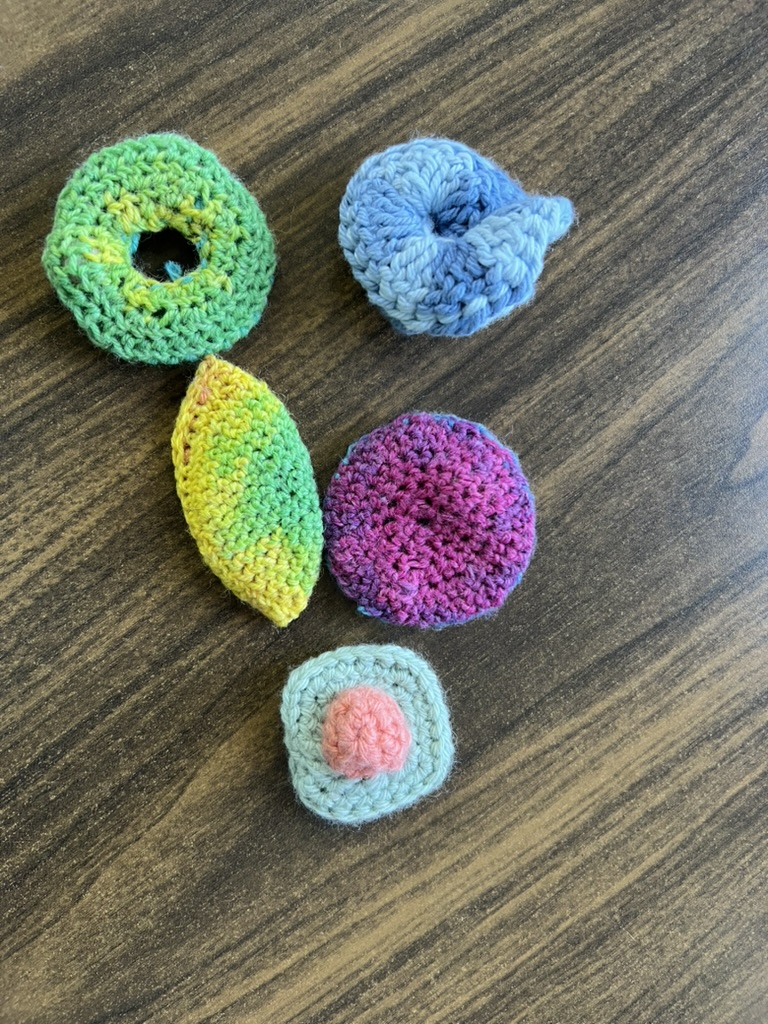
I’m linking the videos I used below. One top tip is to turn on the transcript, so that you can read and use visual cues from the videos.
The crochet mobius ring was the first fidget I made. One adaptation I made to this pattern was to use this alternative for a foundation row.
The pop-it square was great for learning about increasing, decreasing and crocheting into the front loop only.
The marble donut was adapted from this design. I had to adapt the design to use half double stitches rather than single crochet because I was using a thinner yarn and smaller hook size. I also used the alternative foundation row mentioned above because it’s fun.
For my second marble pusher, I used this video to help me. This was another opportunity to practice increasing stitches to create the circular pattern. I also changed the stitches from single stitches to half-double crochet stitches, to get the size right. I also took one circle from this pattern and inserted a simple hair clip into the folded circle to make the pea-shaped click-clack fidget.
I have also recently been brave enough to try the reversible octopus fidget. Though this video is not in English, using subtitles translates the pattern for you.
From unraveled yarn to classroom comfort, my crochet journey has taught me that learning happens when we push ourselves just outside of that comfort zone. Additionally, that even mastering the simplest skills can have a profound impact. It’s a testament to resourcefulness, creativity, and the power of handmade solutions. How can we, as educators, push ourselves just that little bit to find creative solutions in resource-limited environments? What skills do you have that can be used to serve others?


 Honor Learners