Creating Community Through Class Names and Promises

From Endings to Beginnings

At the end of last school year, I wrote about some of the traditions I use to close our year together. Afterwards, several people asked me to share some ideas for the beginning of the year. So here it is—a practice that has become a cornerstone of how I build community with my learners: creating a class name and a class promise. Like all good educators, I learn from others. These traditions are something I learned from my friend and former colleague, Ria, who inspired me to make class names and class promise a part of our classroom culture.

The Hummingbird Story

I like to start with a story that has shaped me since childhood. Wangari Maathai, founder of the Greenbelt Movement in Kenya, Nobel Peace Prize laureate, and my neighbor when I was growing up, often told the parable of the hummingbird.

In the story, a forest is on fire. The big animals stand by, helpless and afraid, while the tiny hummingbird flies back and forth, dropping water on the flames one beakful at a time. The hummingbird says, “I am doing the best I can.”

This story inspires us to think about the qualities we want to embody as a class—small but mighty, resilient, and purposeful. Together, we begin to collect adjectives that describe how we want to be.

Choosing Our Class Name

From there, we make a list of animals. Through discussion, debate, and voting, we narrow our choices down until we land on a combination of one adjective and one animal.

Past classes have been The Helpful Hummingbirds and The Joyful Trying Turtles. This year, after much excitement and thoughtful talk, we proudly became The Kind Foxes.

A class name may sound simple, but it gives learners a powerful sense of identity. It’s something that brings us together as a learning community.

Making Our Class Promise

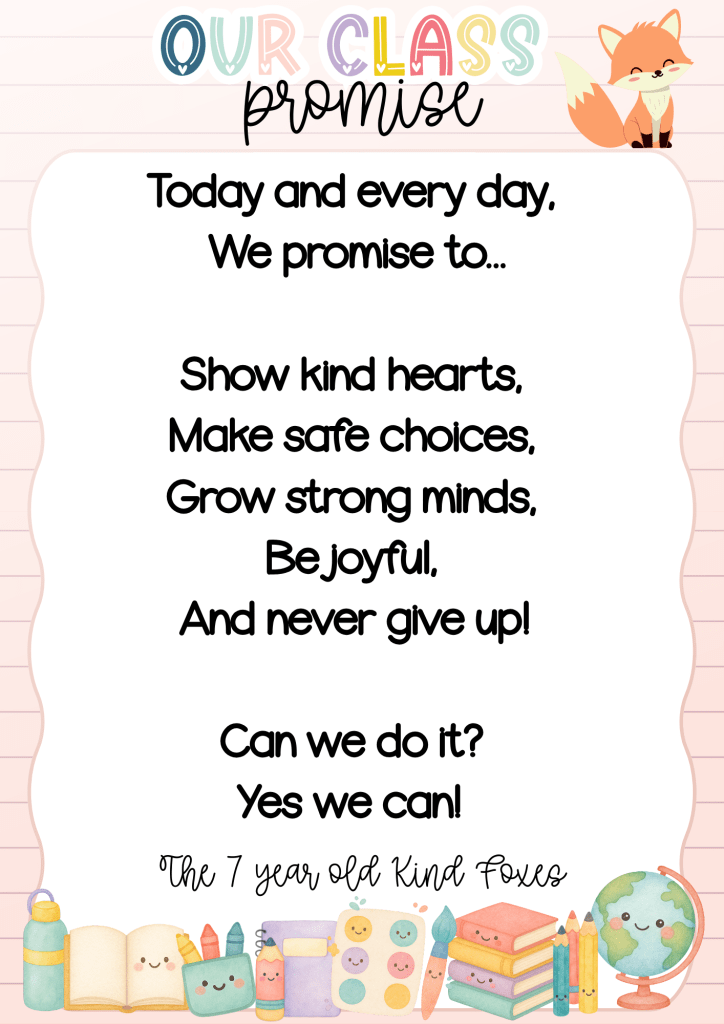
Alongside our name, we also create a class promise. It’s not a list of rules—it’s our shared commitment to how we want to live and learn together. This year’s promise is:

Reciting our promise as a morning chant has become a meaningful ritual. It’s something I first learned during my grade 1 teaching days with Ria, and I’ve carried it with me ever since. Saying it together each day helps anchor our sense of community and it’s a daily reminder for our learners that they helped build the foundation of our classroom community.

Linking to the 4Cs

What I love about this process is how naturally it connects to the 4Cs: Creativity, Collaboration, Communication, and Critical Thinking.

  • Creativity – Learners brainstorm fun, meaningful class names.
  • Collaboration – Learners work together to refine the promise until it represents everyone.
  • Communication – They discuss, debate, and practice explaining their ideas respectfully.
  • Critical Thinking – Learners reflect on which behaviors truly matter for making school safe, joyful, and successful.

The result isn’t just words on a wall. It’s a shared agreement that guides our choices and builds trust, day after day.

Why It Matters

When children feel like they belong to something bigger than themselves, they rise to the expectations they’ve helped to create. Our class name and promise become an anchor, shaping not only the way we treat each other but also the way we approach learning challenges together.

And as the year unfolds, I hear students whispering to each other: “Remember, we promised to keep trying.” That’s when I know it’s working.

From Idea to Interactive: Bringing Learning to Life with Canva Code (and saving precious teacher time too!)

If you had told me a year ago that I’d be coding my own games for class, I probably would have laughed. My experience with coding has been fairly limited: introducing my young students to Scratch Jr., and during lockdown, diving into creating Pixel Art Reveals using Google Sheets – a skill I picked up through many helpful YouTube tutorials and online workshops offered by generous educators. Since then, I’ve admired the potential of educational tech, engaging with it in various ways, but coding felt like a different realm – until recently, when Canva Code offered an opportunity to step back in.

With no real coding experience, I started small: a matching game to review telling time, connecting analogue clocks with digital time. I designed it with three levels of increasing difficulty, and to make it even more engaging, I added a Pac-Man style reward game after each level. In true coding spirit, the game took several iterations to get right—and I quickly learned the value of thorough testing before sharing with students. But the result? It felt like pure magic. My students were genuinely engaged, and their excitement inspired me to keep going.

Next, I created a 2D shape matching game, where students matched shape names with their attribute descriptions. I was inspired by Classnotes with Nicole (I recommend checking out her blog because she shares a free guide to creating Canva Code games and her EASY prompt is really helpful). It was a simpler build—time was tight—but it worked beautifully as a review tool, especially for my multilingual learners who benefit so much from that extra vocabulary support. Seeing them light up as they successfully matched the visuals with the words just hammered home what I already knew: games aren’t just a bit of fun; they’re seriously powerful learning tools in disguise.

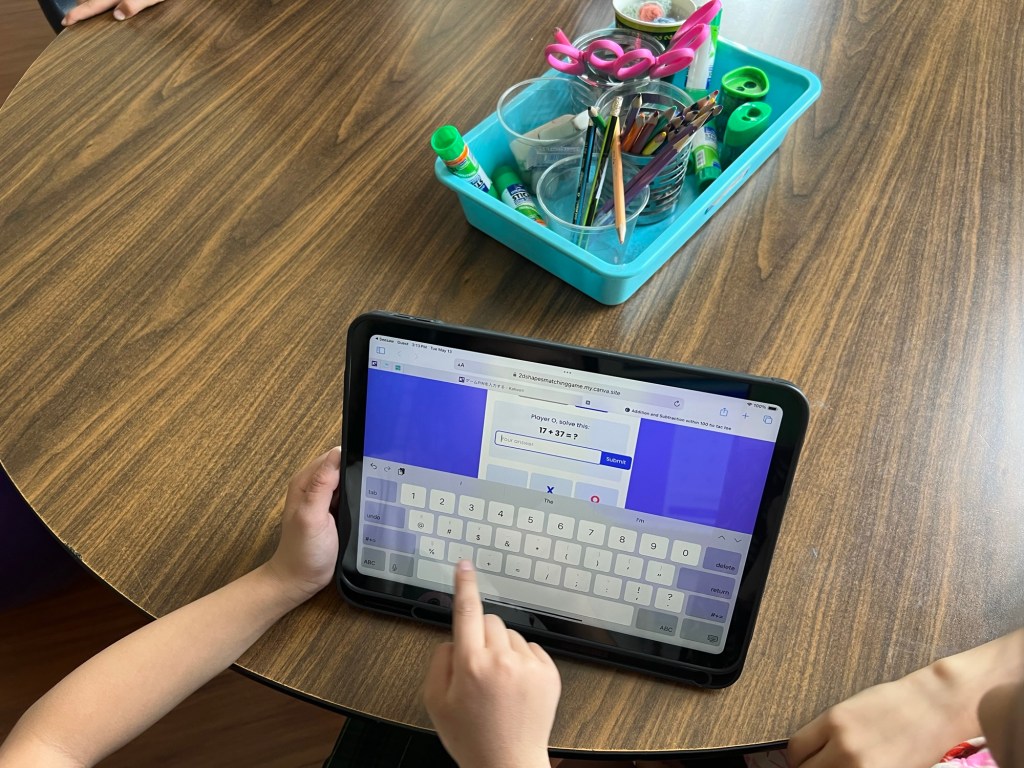
With two games under my belt, I wanted to try something new. As we approach the end of the year, building confidence in mental math is a key focus. So I asked Canva Code to help me create a 2-player tic-tac-toe game—with a twist. Before each move, students must solve a 2-digit addition or subtraction problem (within 100). Get it right, take your turn. Get it wrong, skip your turn. First to three in a row wins.

Now, the first attempt wasn’t exactly flawless – sneaky players could still try to click on a spot that was already taken. So, back to Canva Code I went, and like magic, it was fixed! Then, because every winner deserves a celebration, I added a burst of confetti for the champion and a clear, friendly landing page with all the instructions. The whole thing came together in under 20 minutes. Seriously! It’s quick, totally tailored to what my students need, and reusable – a far cry from those elaborate escape rooms I used to spend hours crafting that got played exactly once.

img_8773

The amazing Canva Code – along with a whole bunch of other super cool new features – will be released very soon! In fact, I even saw a post today hinting that some users (beyond the original first million) might already have access! It’s genuinely thrilling to think about how many more educators will soon have these incredible tools at their fingertips, making it so easy to design, tweak, and bring their awesome classroom ideas to life.

In the meantime, if you’re curious to see what I’ve created so far, feel free to dive in:

🎯 Memory Game for Teaching Time
🔷 2D Shapes Matching Game
➕➖ Addition & Subtraction Tic-Tac-Toe

This shift has been more than just practical—it’s been empowering. Canva Code has allowed me to build games tailored to my learners’ needs, in real time. And the best part? Their reactions. One student said it best:

“I wonder what she’ll ask Canva to code next?”

Learning is fun. And when I’m learning alongside my students, it becomes something even more powerful: joyful, shared discovery.

From Unraveled Yarn to Classroom Comfort: My Crochet Journey Across Continents

Imagine learning to knit, but never how to start. My life has been a series of stitches, some held tight, others unraveled. Little did I know, those stitches would become a way to connect with and support our learners.

Born in Kenya, of Pakistani heritage, and raised as a third culture kid, my childhood was a tapestry of diverse experiences. My older brothers and working parents meant I often found comfort with my nanny. It was she who first introduced me to the world of yarn, teaching me to knit—but, crucially, not how to cast on. That incomplete skill led to a disheartening moment at summer camp when a counselor, faced with my yarn-startless project, simply unraveled it all. That was the end of my first foray into crafting.

Later, as I grew older, my wonderful aunts attempted to teach me sewing and embroidery. But being left-handed in a right-handed world presented its own set of challenges. It felt like I was always working against the grain.

Then, during a winter break in college, while staying with my uncle’s family, I found myself with time and a need for a creative outlet. A trip to Walmart led me to a crochet guide and some yarn. Unsure if I could succeed, I dove in. Through sheer determination and persistence, I taught myself to crochet. My first project? A “belt,” according to my uncle. That “belt” grew into a blanket, a tangible symbol of my newfound skill.

That blanket became a cherished companion, traveling with me from college back to Kenya, and then to the UK as I pursued my teaching education. It was a piece of home in a world of constant change. However, when my family and I embarked on our overseas teaching journey to Mozambique, not everything could make the cut. The blanket, along with many cherished teaching resources, had to be left behind.

Eight years in Mozambique brought new experiences and a growing collection of handmade crochet blankets. But when we moved to Dushanbe, Tajikistan, the cost of shipping was prohibitive. We left with eight suitcases, leaving behind a wealth of possessions. As I transitioned into teaching in this new environment, I carried with me the lessons learned from those early crafting experiences: the value of hands-on learning, the power of creating something from nothing, and the ability to adapt to limited resources. Since moving to Dushanbe, I have ventured beyond single row repeat patterns to tackle more complex projects. The art of crochet is both a challenge to learn, and a mindful, relaxing experience once I master a pattern.

In my last blog post, I discussed addressing the sensory needs of my students. As I developed an intervention, I noticed the need for fidgeting during listening and processing. Previously, I relied on a calm-down corner filled with purchased fidget toys. But sourcing those resources here was a challenge. Then, inspiration struck. Scrolling through Instagram, I discovered @Loumarit and their crocheted fidgets.

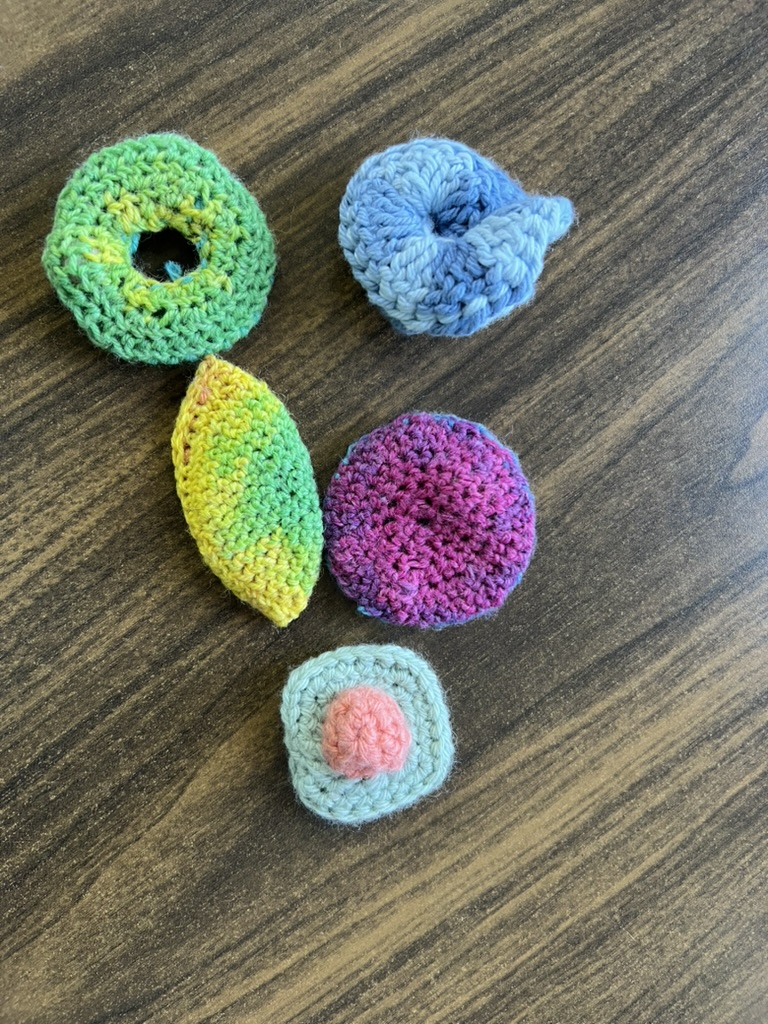
I bought patterns, but quickly realized following them wasn’t my strength. This is why I stuck to making blankets and scarves. Thankfully, YouTube tutorials became my lifeline to push my out of my comfort zone. Through countless hours of practice, I mastered new stitches and techniques. With a bit of adaptation, I created a variety of quiet fidgets that now adorn each table in my classroom. These accessible tools are well-used and help my students focus and regulate their sensory needs.

I’m linking the videos I used below. One top tip is to turn on the transcript, so that you can read and use visual cues from the videos.

The crochet mobius ring was the first fidget I made. One adaptation I made to this pattern was to use this alternative for a foundation row.

The pop-it square was great for learning about increasing, decreasing and crocheting into the front loop only.

The marble donut was adapted from this design. I had to adapt the design to use half double stitches rather than single crochet because I was using a thinner yarn and smaller hook size. I also used the alternative foundation row mentioned above because it’s fun.

For my second marble pusher, I used this video to help me. This was another opportunity to practice increasing stitches to create the circular pattern. I also changed the stitches from single stitches to half-double crochet stitches, to get the size right. I also took one circle from this pattern and inserted a simple hair clip into the folded circle to make the pea-shaped click-clack fidget.

I have also recently been brave enough to try the reversible octopus fidget. Though this video is not in English, using subtitles translates the pattern for you.

From unraveled yarn to classroom comfort, my crochet journey has taught me that learning happens when we push ourselves just outside of that comfort zone. Additionally, that even mastering the simplest skills can have a profound impact. It’s a testament to resourcefulness, creativity, and the power of handmade solutions. How can we, as educators, push ourselves just that little bit to find creative solutions in resource-limited environments? What skills do you have that can be used to serve others?

Keeping Learners Active and Engaged Indoors: Fun and Educational Games for the Classroom

As educators, we all know the importance of keeping our learners active and engaged in the classroom. This is especially true during the winter months when outdoor recess may not be an option, or when air quality is poor as it has been recently here in Dushanbe. But just because we’re stuck inside doesn’t mean we can’t have fun and learn at the same time!

In this blog post, I’ll share some of my favorite games that I’ve been using to keep my learners moving and learning, even when we can’t go outside. These games are all adaptable to different grade levels and subjects, so you’re sure to find something that will work for your class.

1. Which One Doesn’t Belong?

This is a great game for getting learners to think critically and discuss different concepts. To play, simply display a group of four pictures, words, math equations, etc., and label them A, B, C, and D. Ask learners to turn and learn with their partners to discuss which one doesn’t belong. Remind them that there is no right or wrong answer. This pre-discussion is especially helpful for multi-language learners.

Once learners have had a chance to discuss, ask them to vote with their feet by moving to a matching corner in the classroom. Then, bring the class back together and share ideas. To extend their thinking, ask learners to come up with reasons for an answer they did not choose.

2. Musical Chairs

This classic game is a fun way to get learners up and moving while practicing any subject. I found a great resource for musical chairs on Instagram from @headoverheelsforteaching. They also have a product available on Teachers Pay Teachers that includes everything you need to play musical chairs in any subject: Musical Chairs Learning Activity – For Any Subject

3. Ultimate Tic Tac Toe with Collaborative Problem Solving

This is a fantastic game for math class or any subject that involves strategic thinking and teamwork. Played on a large 3×3 grid containing nine smaller tic-tac-toe boards, teams aim to win individual small games and the larger 3×3 grid. The twist? Before placing their mark, every member of a team must collaborate to solve a math problem (or a problem related to the current subject). Once the team agrees on the solution, one member explains their reasoning to the teacher. A correct explanation earns them the right to place their X or O on the chosen small board. This variation fosters collaboration, communication, and reinforces problem-solving skills, giving learners multiple opportunities to demonstrate their understanding and learn from each other.

4. Capture the Flag

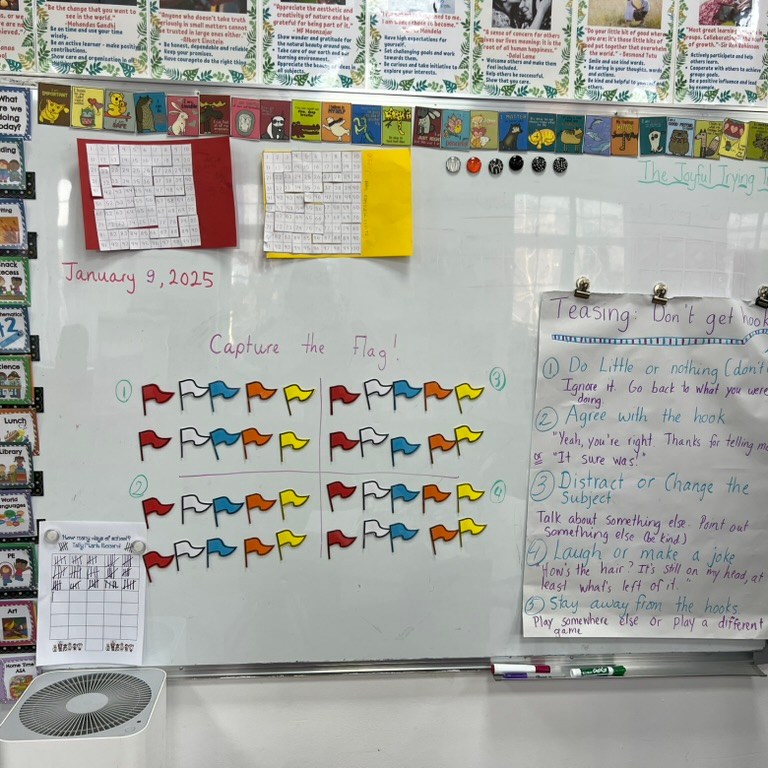
This is a fun and active game that can be adapted to any subject. To play, print out flags on different colored paper, laminate them, and attach magnetic tape so they can be easily stuck to a whiteboard or projector screen. Divide the class into teams and give each team two flags of each color. Assign a point value to each color flag, but don’t share the point system with the learners. After each question, a group can steal a flag from another team if they answer the question correctly. At the end of the lesson, reveal the point value of each flag and calculate which team has the most points. This game gets learners up and moving around the classroom throughout the lesson.

5. Indoor Snowball Fight

Who says you can’t have a snowball fight indoors? This is a fun and engaging way to practice any subject matter. To play, print out snowballs with different questions related to your topic. You can also include some “yellow snow” cards that require learners to do a short exercise routine. Crumple up the snowballs and toss them around the classroom. Learners pick up a snowball, answer the question on a recording sheet, and then complete any exercises if they get a yellow snow card. This game is sure to get your learners moving and learning! Here is a link to a snowball fight resource I created on Canva that can be adapted to any topic: Indoor Snowball Fight

6. Boom, Clap, Snatch (with a Twist!)

This is a quick, easy, and engaging game that can be used to review virtually any material, from true/false statements to phonics sounds. It adds a physical element that gets learners listening attentively and reacting quickly. Here’s how to play:

  • Preparation: Partners sit facing each other. Place a “tented” card (folded in half to stand like a small tent) between them. The card can display a true/false statement, two different phonemes being learned, two vocabulary words, or any other paired items you want learners to distinguish.
  • The Rhythm: Establish a rhythm using body percussion. For example:
    • “BOOM”: Learners pat their laps.
    • “CLAP”: Learners clap their hands.
    • You can create various rhythmic patterns, such as “BOOM, CLAP, CLAP,” “BOOM, BOOM, CLAP,” or even more complex sequences. This adds an element of focus and coordination.
  • The Cue: After establishing the rhythm, you’ll say a cue related to one of the items on the card. For example:
    • If the card has “True” and “False,” you might say, “The capital of France is Paris.”
    • If the card has the phonemes /sh/ and /ch/, you might say the word “ship.”
    • If the card has two vocabulary words, you could give a definition for one of the words.
  • The Snatch: As soon as learners hear the cue, they race to “snatch” (grab) the correct card in front of them. The first learner to grab the correct card wins that round.

This variation of Boom, Clap, Snatch adds a layer of quick thinking and listening comprehension to the physical actions, making it a fun and effective review activity.

7. Quiz, Quiz, Trade

Quiz, Quiz, Trade, a Kagan cooperative learning structure, is another great way to get learners moving and interacting while reviewing material. Here’s how it works: Each learner creates a question or problem related to the topic being studied. For example, when studying place value, learners might write a number in expanded form on a sentence strip and then create a slider to cover one of the addends. Learners then pair up, quiz each other on their questions, and then trade their question strips. They then find a new partner and repeat the process. This allows learners to review the material multiple times with different classmates, reinforcing their understanding and promoting social interaction.

This is a great collection of games to keep your learners active and engaged, even when you’re stuck indoors!

What are your favorite indoor classroom games? Share your ideas and experiences in the comments below! I’d love to hear from you.

Reflection, goal setting and TIM

We have been working towards helping our Kindergarten learners develop an understanding of who they are as learners.  A key element in supporting our learners to take ownership of their learning are the skills of reflection and goal setting.

As part of our writing workshop, we conference with our learners during and after writing.  We encourage them to identify their sunshine, things they did well, and their areas for growth, what they still need to learn. Initially, this required lots of modelling, and now most learners confidently engage in these reflections.

We decided to use the same model of sunshine and growth for our three way conferences. As teachers, we created a Seesaw activity (link) and decided the criteria. However, after being challenged to consider what choices we as teachers were making for our learners that they could make for themselves, our plans changed. I asked my collaborative team if I could lead a lesson that would result in the learners making the decision about the criteria.

With their support, I planned a three part lesson using the Torrance Incubation Method (TIM) and I incorporated some elements of Creative Problem Solving (CPS.) The TIM model is based around incorporating a creativity skill, or approach to creativity as I prefer to call them, into each part of your lesson: heightening anticipation, deepening expectations, and extending the learning. I found the following this resource useful when trying to understand the model myself.

The approach to creativity I chose to integrate into this lesson was ‘putting it into context.’ As we heightened anticipation, we explained the why behind the conference and asked learners for help to decide what learning they wanted to share. As we deepened expectations, we used the creativity tool ‘stick ’em up brainstorming’ to generate ideas of what learning we could share. Finally, in the extending learning, we converged our ideas because we had to take into consideration the length of each conference. We supported learners, by grouping ideas or creating clusters. Then we voted on some or rephrased a few more. We found that the criteria developed and selected by learners was very similar to that of the teachers. The difference was, that they seemed to expect more from themselves!

As a reflection of the conferences, I found that they were the most productive conferences I had been a part of. Most learners were honest with themselves and everyone had goals to work towards. As a teacher, we just need to ensure that we revisit these goals and use them to guide our learning.

To take this further, I decided to plan a series of TIM lessons to focus around goal setting in writing. I decided to work with a group of emergent + writers, who are demonstrating readiness by applying initial sounds and more to their writing.  using a variation of the the gradual increase of independence. The tool was introduced to us by Taryn BondClegg (@makingoodhumans) and designed by Suzzane Kitto (@OrenjiButa) who has shared her resources here.

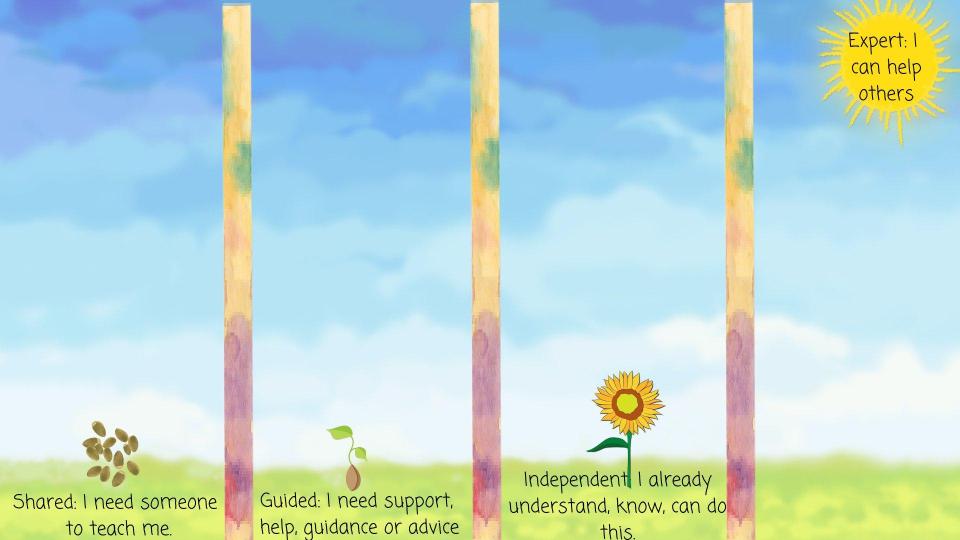
My variation to the gradual increase of independence was to make it more visual for younger learners and link it to our sunshine and growth model.

KG gradual increase of independence

I chose to turn the success criteria for writing that our learners have been generating into visual, movable cards. I was also able to personalize the process by the number and content of the cards.

You can get a copy here.

KG gradual increase of independence (1)

The learning outcome for the lesson was for learners to self assess themselves as writers. The creativity goal was to ’embrace the challenge.’  We heightened anticipation with a word hunt that we then had to puzzle together as a sentence. In the deepening expectation phase, I we explored the metaphor of seeds needing lots of help and sunshine being something that helps seeds grow. I then challenged learners to self assess their learning. The final part of the lesson, extending the learning, was the challenge to find evidence of the criteria in their writing books. This led to interesting discussions about what we were really doing well and things we needed to work on to improve our writing.

For the subsequent lesson, I decided to help learners narrow their focus, by choosing one goal to work on at a time. The creativity goal I chose to integrate was ‘making it swing, make it ring.’ First, I integrated a lot of kinesthetic whole body movement into our phonics lesson prior to writing. We also played a hand mirroring game to heighten anticipation. To deepen expectations, we referred back to our gradual increase of independence and took our discussions from the previous lesson further. Learners began to realize that they could keep doing the things they did well, and spend more attention on what they thought were shared or guided goals. I suggested working on one of those goals at a time might be more productive. Finally, to extend the learning, we came up with actions for each of the criteria we had chosen. The great thing was that each learner had ownership over the goal they chose.

I have begun to see that some learners are really supported by focusing on one goal at a time and are keen to prove it to me during our conferencing.  As I conference with learners, I ask if they want to share their goals with their family. As learners share their goals, they are adding an element of accountability to their learning.  Some have felt ready to do this, and I have embedded the creativity skill of ‘highlighting the essence,’ as I support learners to share both the process and their goals with their families. With permission, here is a link, to one learners’ goal sharing.

Through this series of lessons, I have been embedding approaches to creativity using TIM and I have been applying my own learning to promote learner agency. I found that identifying and embedding the creativity skills or approaches to learning, made lessons more engaging. My next step is to make these approaches to creativity more explicit in our teaching and learning.

I have moved from co-constructed success criteria with learners to learners have interactions with their success criteria and developing a much deeper understanding of how the success criteria supports learning. Learners have made choices and have begun to take action. For those who have not taken action yet, they are beginning to see the need to take ownership for their learning as we reflect and conference, and I am confident they will when they are ready. In addition to engaging in goal setting, learners have been learning about goal setting. With lots of opportunities to choose act and reflect upon goals, it is my hope that our young kindergarten learners will have the skills they need to make informed choices, take risks and continue to grow and learn.

As a final reflection about learner agency, I do not want to say that I am releasing control of the learning, as that is not something I ever had. I would say that am making a conscious effort to support learners to have ownership and accountability of their learning.

Teach Like a Pirate – My Interpretation

Teach Like a Pirate – Increase Student Engagement, Boost Your Creativity, and Transform Your Life as an Educator by Dave Burgess (@daveburgess) is not a new book, yet it is still a relevant and engaging read for educators today. When first published, I remember the hype, but I was not in a place to join the pirate crew. I was about to embark on my own journey to rediscover my passion as an educator that led me back to Africa as an international teacher. Earlier this year, I found the book again as I delved into Twitter and its amazing network for educators. I committed to the decision to find out what it means to ‘teach like a pirate.’ #tlap

My first question was, ‘Why Pirates?’ The answer is twofold. First, it is a mnemonic for the pirate system and philosophy. Second, Burgess defines a pirate as follows:

“Pirates are daring, adventurous, and willing to set forth into unchartered territories with no guarantee of success.”

With this definition in mind, it is easy to see why many educators are joining the pirate crew as we look to shake up education to support our learners to thrive in an ever changing world.

Part I of the book is dedicated to explaining the pirate system and philosophy.
Burgess defines three types of passion. Incorporating passions into our teaching can be a source of motivation for both educators and learners.

Content Passion stems from the areas of curriculum that you are passionate about. When I think back to the subject areas I enjoyed in high school, I would say economics and history. Now my husband would laugh to hear this because I never remember any historical information, nor am particularly financially minded. However, in high school the content passion of my teachers rubbed off on me.

Professional Passion is the reason we become educators. As Burgess wisely surmised, we don’t always have content passion. At these times, we should focus on our professional passions.

Personal Passion doesn’t require a definition. Bringing our passions into our learning spaces means that we are teaching from our strengths and demonstrating to learners how following our passions can lead to learning.

“Your ability to completely give yourself up to the moment and fully ‘be’ with your students is an awesome and unmistakably powerful technique.”

Personally, I have always felt it important to model expectations for learners. If we want them to be fully engaged, then we need to be fully present. Burgess also notes that learners know when we are not truly present. He adds that through immersion, we don’t miss the ‘teachable moments’ because we are right there with them. He goes on to state that this is the ideal way to support struggling learners.

We all want to create an environment where our learners feel safe and valued, an environment where learners are willing to take risks and fail forward. It is paramount to know our learners and build those relationships; learners need to trust us and each other.

I too feel that this connection with our learners is integral to learning, and this is why I value our morning meetings. Following the Responsive Classroom (@responsiveclass) morning meeting structure helps us build our learning community and gives us an opportunity to start our day with a bit of fun through a variety of greetings, sharing, activities and morning messages.
This section of the pirate system and philosophy deals with creativity.

“Creativity is not the possession of some special class of artistic individuals, but is rather something that can be nurtured and developed in all of us – including your students!”

Burgess makes clear that creativity is developed through engaging in the creative process. “It is the process of consistently asking the right questions.” He goes on to add the importance of actively seeking answers. “Your brain won’t be happy until it has provided the answers.”

This reminded me of the process of diffused thinking. This is when you think of a problem and then relax and drift off. When you awaken, your brain has incubated ideas for focused thinking. This is explained better by Barbara Oakley (@barbaraoakley) in this video.

To take it further, I see Creative Problem Solving (CPS, #CreativeProblemSolving) as a way to transform learning experiences to both engage and empower learners. CPS approaches problems or challenges by developing new ideas following a process. The process begins with clarifying a problem to ask the right questions. Divergent thinking is used to generate ideas, and convergent thinking to evaluate and develop ideas. This leads to action or implementation. I look forward to sharing how I find ways to use CPS in education in future posts.

Transformation is about making learning irresistible to learners. To do this we need to know our learners and position and personalize learning to make it relevant. I think this ties in beautifully with learner agency, giving learners voice, choice and ownership of their learning.

Burgess suggests that if you only have one takeaway from this system, it is to ramp up the enthusiasm in your learning space. If you ‘act as if’ you are enthusiastic, you will begin to feel it. If that is not enough, “Make a conscious decision to focus on what empowers you.”

Bringing together passion and enthusiasm will make learning memorable. Last year, I has the opportunity to visit with my year 1 class from 2012. As they shared their memories with me, I was amazed by what they had retained. One asked me if I remembered what a cephalothorax was and others sang a dinosaur song I had forgotten. Neither spiders and dinosaurs are subject areas I am particularly passionate about, but I brought my professional passion, creativity and enthusiasm to our learning space, and made learning memorable.

Part II: Crafting Engaging Lessons

After outlining the pirate system and philosophy, Burgess moves onto the ‘How.’ He suggests working collaboratively to engage in the creative process to enhance the presentation of learning experiences. He shares a toolbox of strategies to energize lessons. He calls these hooks. They are questions designed to help you consider elements in your lessons. Burgess groups his hooks to incorporate different elements such as movement, art, music, drama and dance, STEM, props, suspense, etc.

“How can I harness the power of connecting my content to what students are already interested in?”

“Can they create something ‘real’ that will be more than a classroom project, but also allow them to interact with the world in an authentic way?”

“What types of essential questions can I ask that allow students the opportunity for personal reflection and growth?”

Again, I see the potential for using CPS tools in conjunction with Burgess’ hooks to promote engaging learning. To take it further, I would like to co-construct with learners to empower them.

Part III : Building a Better Pirate

In this final section, Burgess begins by asking:

“Do you want to be great?”

He suggests that great educators benefit learners and mediocrity fails to motivate learners. He then considers what holds us back:

  • The fear of failure
  • The belief that we need to have it all figured out before we begin
  • Paralyzing perfectionism
  • Lack of focus, or focusing on the insignificant
  • Fear of criticism or ridicule
  • Burgess makes three recommendations to overcome these barriers.
  • First, take action and overcome the inertia. Once you get started, the ball starts rolling.
  • Second, find a crew. Burgess advices you to grow your Professional Learning Network (#PLN.) Seek multiple perspectives, read widely, seek professional development, collaborate and reach out on social media.
  • Finally, share treasures. Reach out and share your experiences. #tlap
  • My Final Thoughts
  • As an educator who has lost and found my passion, faced criticism and struggled on my journey, there have been many takeaways from this book. Some of my own practice reflects the pirate system and I can see myself integrating more, especially as I look to give learners more autonomy. I am excited to join the pirate crew and strive for excellence.
  • “Striving for excellence and full engagement is about getting better. It’s about adapting, adjusting, and trying to tweak and improve everything you do.”

  • Lastly, I leave you with a visual hook. It’s unlikely to be an original idea as I’m sure others have created iMovie trailers, but after all this writing, I needed to play!

Images used in the video sourced from Pixabay.

Should you wish to see Dave Burgess in action, click on the photo below.

References:

Burgess, D. (2012). Teach like a pirate: Increase student engagement, boost your creativity, and transform your life as an educator. San Diego, CA: Dave Burgess Consulting.