Empowering Young Writers: AI and App Smashing in the Elementary Classroom

A year ago, I shared my initial foray into incorporating AI in education, moving from skepticism to a sense of pioneering spirit (you can read about it here: https://honorlearners.com/2024/02/18/from-skeptic-to-pioneer-my-journey-into-incorporating-ai-in-education/). Today, I’m thrilled to share how I brought the power of AI to my 2nd-grade learners through an engaging app smash using Magic School AI, Seesaw, and Book Creator. This experience not only boosted their writing skills but also ignited their curiosity and creativity.

The Power of Each App: A Quick Recap

Seesaw: Our digital hub, fostering student portfolios, reflection, and family communication.

Magic School AI: The educator’s ally, providing AI-powered tools for lesson planning, resource generation, and personalized feedback.

Book Creator: The creative canvas, empowering students to design and publish their own digital books.

Our App Smash Journey: Step by Step

Igniting Curiosity with Magic School AI:

We began by tapping into Magic School AI’s Informational Text tool. Our learners chose a variety of topics that sparked their interest, and Magic School AI generated informational texts that served as a springboard for their learning. This step not only provided valuable content but also demonstrated how AI can be a powerful research tool.

Research, Note-Taking, and Drafting:

After absorbing the AI-generated texts, the learners delved deeper, conducting further research and taking detailed notes. They then crafted their own informational texts, demonstrating their understanding of the topics.

Seesaw: The Digital Drafting Space:

Learners typed their drafts into Seesaw, saving them as works in progress. Seesaw’s versatility allowed them to easily revise and refine their writing. It also documented the writing process, allowing families to see the steps we took to edit and revise our writing.

Magic Student: AI-Powered Revision and Feedback:

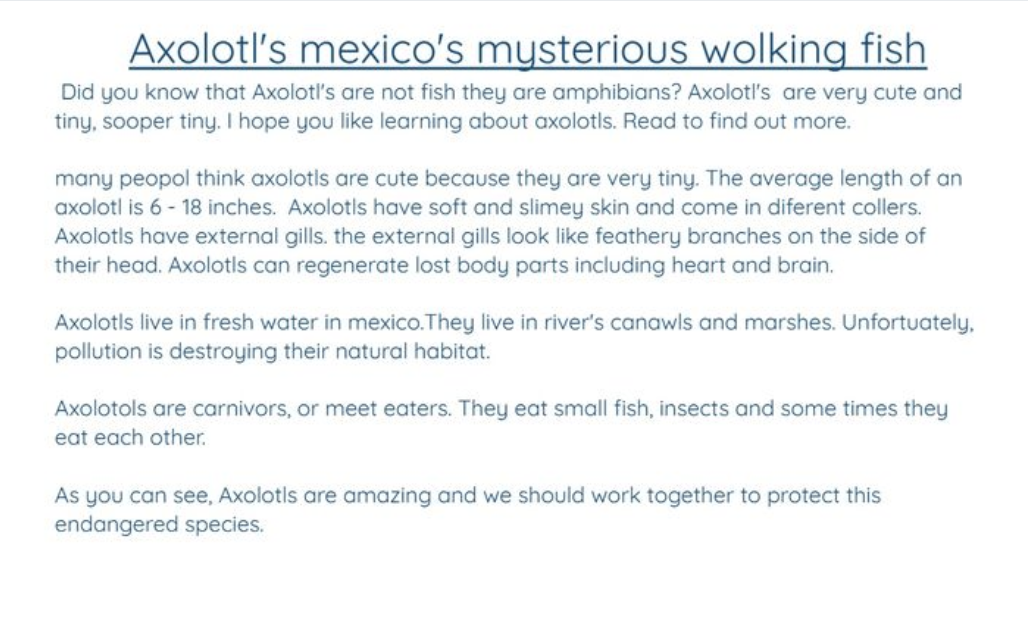
This is where the magic truly happened. I launched a Magic Student room with three key tools: Text Proofreader, Writing Feedback, and the Raina Chatbot. To ensure feedback was aligned with our learning objectives, I uploaded a copy of our writing rubric. I shared the link to the Magic Student room in Seesaw, and learners used their tech code names (color, animal, number) to protect their identity. What’s particularly powerful about the Magic Student room is the transparency it offers teachers. Teachers can see how learners are interacting with each of the tools, identifying areas where they excel and where they needed additional support. As it was the first time, our learners were using Magic Student, and navigating multiple tabs, the following steps were done with my support. After all, they are only 7!

Text Proofreader:

Learners copied their text from Seesaw into the Text Proofreader, receiving instant feedback on grammar and spelling. We duplicated the page in Seesaw and pasted the feedback, allowing students to make direct edits. As they edited, I provided targeted instruction on spelling patterns and grammatical rules.

Writing Feedback:

Learners then copied their edited text into the Writing Feedback tool, which provided constructive feedback on the strengths and areas for growth in their writing. This feedback was copied into Seesaw, and used as a guide for revision.

Raina Chatbot:

We used a combination of the Writing Feedback tool and the Raina Chatbot to revise sections of their text, focusing on enhancing vocabulary and adding descriptive details. Some learners even expanded their texts by adding new paragraphs based on the feedback they received.

A side note: If you want more information about writing tools that can be used to support learners in Magic School Student, check out this recent Webinar hosted by both Magic School AI and Book Creator. It was inspiring enough for me to take the free Book Creator Certified Author course.
Book Creator: Publishing Our Informational Books:

With their revised texts in hand, learners copied their work into Book Creator. They then transformed their writing into beautifully designed digital books, adding images and multimedia elements. Some learners went above and beyond, incorporating tables of contents and glossaries.

Seesaw: Sharing Our Published Works:

As published authors, learners proudly shared their digital books with their families via Seesaw. We downloaded them as PDFs, uploaded them to Seesaw and added the published book link to the first page. We also shared our books by reading them to a younger class, which was a very rewarding experience.

This app smash journey had a profound impact on my 2nd-grade learners. They experienced firsthand the power of AI as a valuable tool for both learning and creativity. The learners developed a deeper understanding of the writing process, moving beyond simple drafting to engage in meaningful revision and refinement. They gained confidence in their ability to use technology to enhance their learning, becoming more comfortable and proficient with digital tools. Furthermore, they learned valuable lessons about digital citizenship, understanding the importance of protecting their identity online while engaging with AI platforms.

This experience reinforced several key takeaways regarding the integration of AI in elementary education. Firstly, AI can be a valuable and accessible tool for even young learners, fostering creativity and critical thinking. Secondly, app smashing, when thoughtfully planned, creates engaging and meaningful learning experiences that resonate with learners. Finally, providing clear guidance, support, and a structured framework is essential for the successful integration of AI, ensuring that students can maximize its benefits while navigating potential challenges.

I sincerely encourage you to explore the vast possibilities of AI within your own classroom. Take the leap and experiment with app smashing, discovering firsthand how it can transform your teaching practices and enrich your students’ learning experiences. Share your own AI integration stories in the comments below, fostering a community of educators who are passionate about leveraging technology to empower the next generation of learners. Let’s continue to learn from each other and push the boundaries of educational innovation.

From Unraveled Yarn to Classroom Comfort: My Crochet Journey Across Continents

Imagine learning to knit, but never how to start. My life has been a series of stitches, some held tight, others unraveled. Little did I know, those stitches would become a way to connect with and support our learners.

Born in Kenya, of Pakistani heritage, and raised as a third culture kid, my childhood was a tapestry of diverse experiences. My older brothers and working parents meant I often found comfort with my nanny. It was she who first introduced me to the world of yarn, teaching me to knit—but, crucially, not how to cast on. That incomplete skill led to a disheartening moment at summer camp when a counselor, faced with my yarn-startless project, simply unraveled it all. That was the end of my first foray into crafting.

Later, as I grew older, my wonderful aunts attempted to teach me sewing and embroidery. But being left-handed in a right-handed world presented its own set of challenges. It felt like I was always working against the grain.

Then, during a winter break in college, while staying with my uncle’s family, I found myself with time and a need for a creative outlet. A trip to Walmart led me to a crochet guide and some yarn. Unsure if I could succeed, I dove in. Through sheer determination and persistence, I taught myself to crochet. My first project? A “belt,” according to my uncle. That “belt” grew into a blanket, a tangible symbol of my newfound skill.

That blanket became a cherished companion, traveling with me from college back to Kenya, and then to the UK as I pursued my teaching education. It was a piece of home in a world of constant change. However, when my family and I embarked on our overseas teaching journey to Mozambique, not everything could make the cut. The blanket, along with many cherished teaching resources, had to be left behind.

Eight years in Mozambique brought new experiences and a growing collection of handmade crochet blankets. But when we moved to Dushanbe, Tajikistan, the cost of shipping was prohibitive. We left with eight suitcases, leaving behind a wealth of possessions. As I transitioned into teaching in this new environment, I carried with me the lessons learned from those early crafting experiences: the value of hands-on learning, the power of creating something from nothing, and the ability to adapt to limited resources. Since moving to Dushanbe, I have ventured beyond single row repeat patterns to tackle more complex projects. The art of crochet is both a challenge to learn, and a mindful, relaxing experience once I master a pattern.

In my last blog post, I discussed addressing the sensory needs of my students. As I developed an intervention, I noticed the need for fidgeting during listening and processing. Previously, I relied on a calm-down corner filled with purchased fidget toys. But sourcing those resources here was a challenge. Then, inspiration struck. Scrolling through Instagram, I discovered @Loumarit and their crocheted fidgets.

I bought patterns, but quickly realized following them wasn’t my strength. This is why I stuck to making blankets and scarves. Thankfully, YouTube tutorials became my lifeline to push my out of my comfort zone. Through countless hours of practice, I mastered new stitches and techniques. With a bit of adaptation, I created a variety of quiet fidgets that now adorn each table in my classroom. These accessible tools are well-used and help my students focus and regulate their sensory needs.

I’m linking the videos I used below. One top tip is to turn on the transcript, so that you can read and use visual cues from the videos.

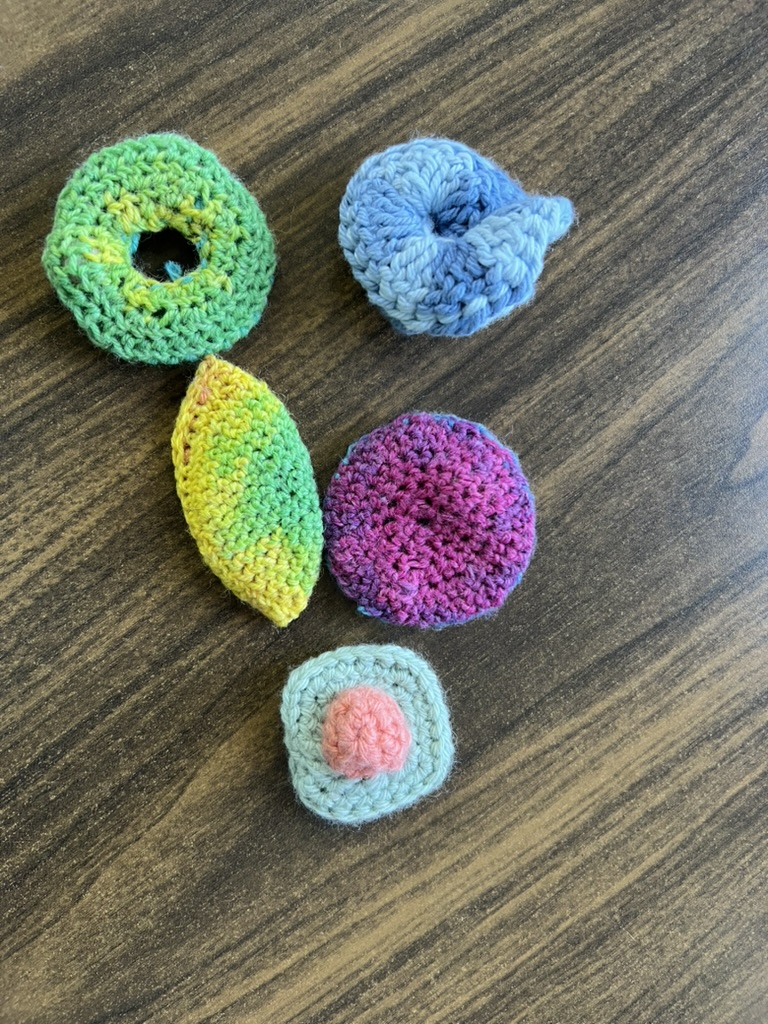
The crochet mobius ring was the first fidget I made. One adaptation I made to this pattern was to use this alternative for a foundation row.

The pop-it square was great for learning about increasing, decreasing and crocheting into the front loop only.

The marble donut was adapted from this design. I had to adapt the design to use half double stitches rather than single crochet because I was using a thinner yarn and smaller hook size. I also used the alternative foundation row mentioned above because it’s fun.

For my second marble pusher, I used this video to help me. This was another opportunity to practice increasing stitches to create the circular pattern. I also changed the stitches from single stitches to half-double crochet stitches, to get the size right. I also took one circle from this pattern and inserted a simple hair clip into the folded circle to make the pea-shaped click-clack fidget.

I have also recently been brave enough to try the reversible octopus fidget. Though this video is not in English, using subtitles translates the pattern for you.

From unraveled yarn to classroom comfort, my crochet journey has taught me that learning happens when we push ourselves just outside of that comfort zone. Additionally, that even mastering the simplest skills can have a profound impact. It’s a testament to resourcefulness, creativity, and the power of handmade solutions. How can we, as educators, push ourselves just that little bit to find creative solutions in resource-limited environments? What skills do you have that can be used to serve others?

From Fads to Focus: My Journey with Sensory Integration in the Classroom

Early in my teaching career, Brain Gym was all the rage. Those 2-3 minute activities, designed to get learners moving and crossing the midline, were supposed to boost focus. While it felt like just another educational fad, something resonated with me. I saw the value in getting kids moving. Years later, as a Kindergarten teacher, I began to understand why. I learned about the importance of core strength for writing and sitting, and I discovered the power of multisensory learning. We incorporated movement breaks (Go Noodle is a fantastic resource), and I thought I was doing enough. I was wrong.

My real education began when I met a young learner I’ll call “Sunshine Bug.” She had a remarkable ability to notice and appreciate the natural world around her, and her smile was infectious. In kindergarten, she was the child who hugged my legs during story time and joyfully embraced every messy activity. I had the pleasure of teaching her again in second grade. This time, she cartwheeled and twirled through the classroom instead of simply walking, and she spent recess lying on her stomach on the swings. One day, she shared something that profoundly shifted my perspective: the world, she explained, was always in motion, and unless she moved with it, things didn’t make sense. It was as if everything was spinning unless her feet were in the air or she was receiving a hug. That moment was a turning point. Working closely with her parents, we implemented several strategies: frequent swing breaks, a weighted blanket, wiggle seats, and a self-massage routine. Just as these supports were taking effect, the COVID-19 pandemic hit, and we were all thrust into the challenges of online learning.

Since then, I’ve been integrating everything I learned from my previous students. And it worked, mostly. Until this year. This year’s second grade class class has been one of the most challenging I’ve ever worked with, but it’s also been an incredible opportunity for growth. Many learners needed intense support to focus and be ready to learn. They struggled to stay in their seats, keep their hands to themselves, and their pencils were either being chewed or used to build miniature towers while they tried to listen. It has taken all the classroom management tools I’ve added to my toolbox over the years to establish routines, but some learners needed more. That’s when our learning support teacher visited. She recommended a sensory diet intervention for some of our learners. We talked through our ideas and decided to add yoga balls as alternative seating and create a choice board with 12 sensory integration activities. Learners would choose three activities to complete each day, in addition to the whole-class movement breaks we already did.

I researched sensory diet choice boards and eventually created my own using Canva. The activities range from playing with play dough and rolling on a yoga ball to blowing bubbles and doing yoga. I also incorporated resources like Coach Corey Martin’s Jump Battles and a fantastic 7-minute HIIT workout from He’s Extraordinary ( a great site with so much information and loads of free resources). This combination of activities helps address a variety of sensory needs.

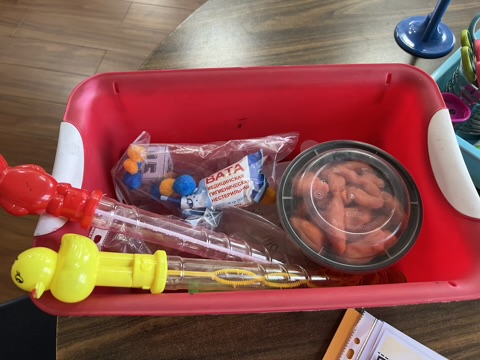
I cut out and laminated the choice cards. I added little velcro dots so they can be stuck onto the choice board. I usually change the choices available once a week. Students can then choose three activities during their session. As an activity is completed, they can move the card to the completed section. I’ve gathered all the materials in one place and I’ve added a little sand timer to the box to put a time limit on some activities.

It’s still early days, but I’m already seeing positive changes. Learners seem more focused, and there are fewer disruptions. It’s also interesting to observe the choices of activities learners choose as they learn to listen to their body and what it needs. Naturally, we have not been able to implement this for everyone in the class, but other learners have benefited from the flexible yoga ball seating and it has given me some insight into their sensory needs too.

It’s been a journey, from my initial understanding of movement in learning with Brain Gym to recognizing the complex sensory needs of my students. This experience has reinforced the importance of continuous learning, adapting to individual needs, and seeking support from colleagues.

Now, I’m sharing my sensory diet choice board with you! I hope it’s a helpful resource in your classroom or home.

What are your favorite sensory activities for kids? Share your ideas in the comments below! I’d love to hear from you. And if you found this post helpful, please share it with other educators and parents!

Keeping Learners Active and Engaged Indoors: Fun and Educational Games for the Classroom

As educators, we all know the importance of keeping our learners active and engaged in the classroom. This is especially true during the winter months when outdoor recess may not be an option, or when air quality is poor as it has been recently here in Dushanbe. But just because we’re stuck inside doesn’t mean we can’t have fun and learn at the same time!

In this blog post, I’ll share some of my favorite games that I’ve been using to keep my learners moving and learning, even when we can’t go outside. These games are all adaptable to different grade levels and subjects, so you’re sure to find something that will work for your class.

1. Which One Doesn’t Belong?

This is a great game for getting learners to think critically and discuss different concepts. To play, simply display a group of four pictures, words, math equations, etc., and label them A, B, C, and D. Ask learners to turn and learn with their partners to discuss which one doesn’t belong. Remind them that there is no right or wrong answer. This pre-discussion is especially helpful for multi-language learners.

Once learners have had a chance to discuss, ask them to vote with their feet by moving to a matching corner in the classroom. Then, bring the class back together and share ideas. To extend their thinking, ask learners to come up with reasons for an answer they did not choose.

2. Musical Chairs

This classic game is a fun way to get learners up and moving while practicing any subject. I found a great resource for musical chairs on Instagram from @headoverheelsforteaching. They also have a product available on Teachers Pay Teachers that includes everything you need to play musical chairs in any subject: Musical Chairs Learning Activity – For Any Subject

3. Ultimate Tic Tac Toe with Collaborative Problem Solving

This is a fantastic game for math class or any subject that involves strategic thinking and teamwork. Played on a large 3×3 grid containing nine smaller tic-tac-toe boards, teams aim to win individual small games and the larger 3×3 grid. The twist? Before placing their mark, every member of a team must collaborate to solve a math problem (or a problem related to the current subject). Once the team agrees on the solution, one member explains their reasoning to the teacher. A correct explanation earns them the right to place their X or O on the chosen small board. This variation fosters collaboration, communication, and reinforces problem-solving skills, giving learners multiple opportunities to demonstrate their understanding and learn from each other.

4. Capture the Flag

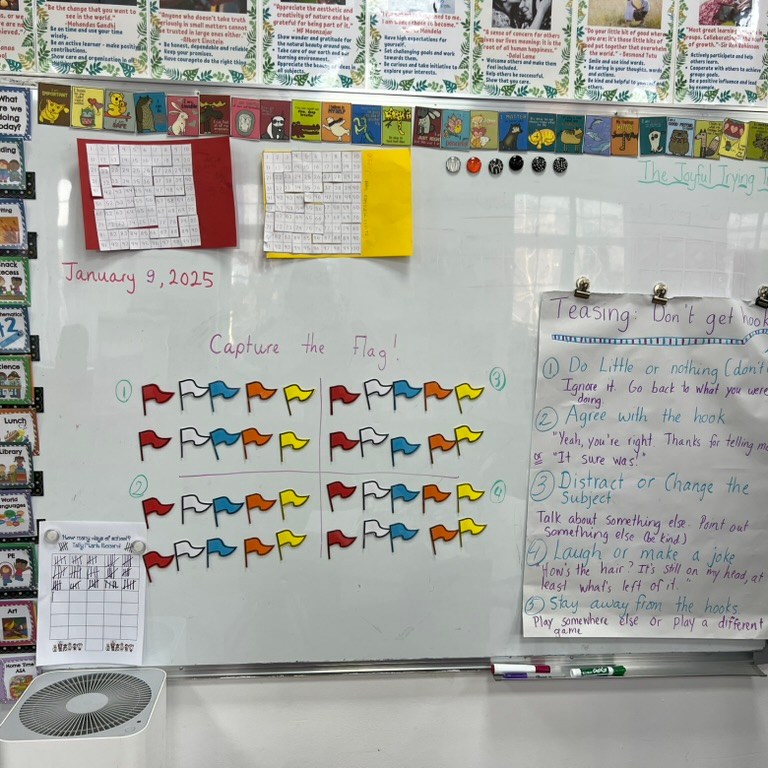
This is a fun and active game that can be adapted to any subject. To play, print out flags on different colored paper, laminate them, and attach magnetic tape so they can be easily stuck to a whiteboard or projector screen. Divide the class into teams and give each team two flags of each color. Assign a point value to each color flag, but don’t share the point system with the learners. After each question, a group can steal a flag from another team if they answer the question correctly. At the end of the lesson, reveal the point value of each flag and calculate which team has the most points. This game gets learners up and moving around the classroom throughout the lesson.

5. Indoor Snowball Fight

Who says you can’t have a snowball fight indoors? This is a fun and engaging way to practice any subject matter. To play, print out snowballs with different questions related to your topic. You can also include some “yellow snow” cards that require learners to do a short exercise routine. Crumple up the snowballs and toss them around the classroom. Learners pick up a snowball, answer the question on a recording sheet, and then complete any exercises if they get a yellow snow card. This game is sure to get your learners moving and learning! Here is a link to a snowball fight resource I created on Canva that can be adapted to any topic: Indoor Snowball Fight

6. Boom, Clap, Snatch (with a Twist!)

This is a quick, easy, and engaging game that can be used to review virtually any material, from true/false statements to phonics sounds. It adds a physical element that gets learners listening attentively and reacting quickly. Here’s how to play:

  • Preparation: Partners sit facing each other. Place a “tented” card (folded in half to stand like a small tent) between them. The card can display a true/false statement, two different phonemes being learned, two vocabulary words, or any other paired items you want learners to distinguish.
  • The Rhythm: Establish a rhythm using body percussion. For example:
    • “BOOM”: Learners pat their laps.
    • “CLAP”: Learners clap their hands.
    • You can create various rhythmic patterns, such as “BOOM, CLAP, CLAP,” “BOOM, BOOM, CLAP,” or even more complex sequences. This adds an element of focus and coordination.
  • The Cue: After establishing the rhythm, you’ll say a cue related to one of the items on the card. For example:
    • If the card has “True” and “False,” you might say, “The capital of France is Paris.”
    • If the card has the phonemes /sh/ and /ch/, you might say the word “ship.”
    • If the card has two vocabulary words, you could give a definition for one of the words.
  • The Snatch: As soon as learners hear the cue, they race to “snatch” (grab) the correct card in front of them. The first learner to grab the correct card wins that round.

This variation of Boom, Clap, Snatch adds a layer of quick thinking and listening comprehension to the physical actions, making it a fun and effective review activity.

7. Quiz, Quiz, Trade

Quiz, Quiz, Trade, a Kagan cooperative learning structure, is another great way to get learners moving and interacting while reviewing material. Here’s how it works: Each learner creates a question or problem related to the topic being studied. For example, when studying place value, learners might write a number in expanded form on a sentence strip and then create a slider to cover one of the addends. Learners then pair up, quiz each other on their questions, and then trade their question strips. They then find a new partner and repeat the process. This allows learners to review the material multiple times with different classmates, reinforcing their understanding and promoting social interaction.

This is a great collection of games to keep your learners active and engaged, even when you’re stuck indoors!

What are your favorite indoor classroom games? Share your ideas and experiences in the comments below! I’d love to hear from you.

Honoring Learners: Meeting Them Where They Are

Seven years ago, I was encouraged to step into the world of online sharing, joining Twitter and starting this very blog, “Honor Learners,” with the goal of connecting with fellow international educators and sharing my practice. Ironically, I recently stepped away from Twitter on my seven-year anniversary—and my blogging has been sporadic, to say the least. Part of that has been a lack of confidence. I’ve been surrounded by so many incredible educators who possess deep expertise in specific subject areas, and I’ve learned so much from them. Yet, my own educational journey has always been driven by a different focus: meeting learners where they are, which has led me down many different paths.

This journey has been anything but linear. It’s been a winding road of exploration, adaptation, and continuous learning, all in service of honoring my learners.

When the pandemic first hit, like many educators, my primary focus was survival—keeping learners engaged and connected in a suddenly virtual world. I dove into the world of Bitmoji classrooms, created pixel art activities to add a spark of fun to skill practice, and designed digital escape rooms to boost motivation. It was a time of frantic adaptation, a testament to the resilience of educators everywhere.

As the pandemic continued and the initial shock subsided, my focus shifted to a pressing need: supporting struggling readers. This led me to implement a speech-to-print approach, which proved incredibly effective in helping students develop decoding skills. This work became the focus of my action research for my Master’s in Education, allowing me to delve deeply into the practical applications and theoretical underpinnings of this method. But I felt we needed to go deeper. This led me to explore Structured Word Inquiry, realizing the importance of morphology and etymology in addition to phonics. I was starting to see the interconnectedness of language in a new light.

More recently, my focus has turned to helping students navigate the rapidly evolving world of AI. It’s here, it’s not going away, and it’s crucial that we equip our learners with the skills and understanding they need to thrive in this new landscape.

Looking back, I realize that these seemingly disparate explorations—from Bitmoji classrooms to Structured Word Inquiry to AI literacy—are all connected by a common thread: my commitment to meeting learners where they are. This is what “Honor Learners” is all about.

I’ve often hesitated to share my experiences because I’ve felt like there are “better” experts out there. But I’m realizing that my journey, with all its twists and turns, is valuable in itself. It’s a reflection of the dynamic and ever-changing nature of education, especially in our interconnected global community.

My goal now isn’t to present myself as an expert in any one area. It’s to share my journey, to be transparent about my learning process, and to connect with other educators who are also navigating this complex and beautiful landscape. It’s about honoring my learners by sharing how I’ve tried to meet them where they are, in all their diverse and evolving needs.

Reflecting on my own experiences, I recall a specific instance that beautifully illustrates this. As part of my ongoing quest to embed Structured Word Inquiry into our learning, I took a course offered by Marie Foley on Using Visual Narratives to Explain Concepts in Orthography. This course opened up a whole new world for me, introducing me to the power of visual storytelling in explaining complex language concepts. I learned how to use Canva to create engaging videos, and even more importantly, I crafted these videos with my learners. It became a collaborative learning experience, where they not only deepened their understanding of orthography but also gained valuable digital literacy skills by learning how to use Canva themselves. We then shared these videos with parents on Seesaw, creating a bridge between the classroom and home. I recall one parent sharing their heartfelt appreciation, explaining how the videos sparked rich conversations at home and extended the learning beyond the school day. This experience was a powerful reminder that meeting learners where they are isn’t just about addressing their academic needs; it’s about empowering them with skills, fostering connections with their families, and creating a shared learning experience that extends beyond the classroom walls. It solidified my belief that meeting learners where they are is not a static destination, but a continuous journey of learning, adaptation, and reflection.

“Honor Learners” is more than a blog title; it’s a testament to the belief that every student deserves to be met where they are, and that our own journeys as educators are valuable contributions to the global conversation.

What has your educational journey looked like? What challenges and discoveries have shaped your approach to meeting learners where they are? Share your reflections in the comments below.

From Skeptic to Pioneer: My Journey into Incorporating AI in Education

At the start of the school year, if you had asked me about using AI in my teaching, my response would have been a firm no. I harboured skepticism about whether AI could truly enhance my role as an educator or bring added value to my learners’ learning experiences. However, a series of eye-opening experiences and a shift in perspective have led me to embrace AI tools in the classroom. Please note that both AI tools mentioned in this blog, do require setting up an account, which can be done for free.

In November, I attended a regional professional development session organized by our school. During this event, I had the chance to participate in various sessions led by fellow educators from our network. As the school’s social media manager, I discovered how colleagues were leveraging ChatGPT to streamline the process of generating engaging social media posts. Intrigued, I decided to give it a try, and the results were astonishing. Not only did it simplify the content creation process, but it also saved me valuable time that I would have otherwise spent agonizing over each word.

Another AI tool that caught my attention was Magic School AI, specifically designed to assist educators in optimising their workflow. With over 60 tools tailored for teachers, I started experimenting with the Report Card Comments tool. Inputting a student’s pronoun, strengths, and areas for growth resulted in a professionally generated comment in a matter of seconds. While convenient, I quickly adopted the best practice of maintaining an 80:20 ratio to ensure that my unique voice still resonated in AI-generated comments.

Curiosity piqued, I began to explore the possibilities of using Magic School AI to further streamline my responsibilities as an educator. Opting for the three levels of free training offered by the platform, I gradually became more comfortable integrating AI into my daily routine. The certification process, taking only 15-20 minutes for each level, empowered me with the knowledge to make informed decisions about incorporating AI into my teaching practices.After completing all three levels, I took the next step and applied to become a Pioneer and a Magic School AI Certified Educator.

While Magic School AI has proven invaluable in streamlining my lesson planning, I’d like to shine a spotlight on some additional tools that have become essential in saving me time on a daily basis.

1. Professional Email Tool: One of my go-to AI tools is the Professional Email tool, a game-changer for crafting concise and professionally worded emails. By inputting bullet points outlining my message, the tool swiftly generates a polished email. This has been a tremendous time-saver, allowing me to communicate effectively without sacrificing the quality of my correspondence.

2. Email Family Tool: Maintaining a professional yet friendly tone while connecting with families is crucial, and the Email Family tool excels at this. It’s important to note the significance of not sharing identifying or confidential information in any AI prompt. Recently, I needed to inform a parent about upcoming content in our Math class. Leveraging Raina, the chatbot associated with this Magic School AI, I effortlessly generated descriptions of the strategies we would be using in class. This proved especially beneficial as the strategies we employ in mathematics may differ from those parents learned during their school years. Below is an excerpt from the subsequent email I sent:

“Throughout the unit, we’ll showcase various strategies for both addition and subtraction. These strategies for addition include:

  1. Traditional Algorithm: We will reinforce the standard method of adding numbers, starting from the rightmost digits and carrying over when necessary.
  2. Place Value Strategy: Students will learn to break down numbers into their place value components (ones, tens, hundreds) and add them separately before combining the results.
  3. Base Ten Blocks: We will utilize base ten blocks, a visual representation of ones, tens, and hundreds, to help students understand the concept of addition and regrouping.
  4. Number Line: Students will practice adding numbers using a number line, which helps them visualize the progression from one number to another.
  5. Mental Math: We will encourage students to develop mental math strategies, such as adding multiples of ten or using friendly numbers to simplify calculations.

By exploring these strategies, students will gain a deeper understanding of addition and develop flexibility in choosing the most efficient method for different types of problems.”

3. Math Spiral Review Tool: Gone are the days of spending countless hours generating homework assignments. With the Math Spiral Review tool, I now efficiently create relevant homework tailored to the grade level, specific topics, desired number of questions, and any additional criteria. In a matter of seconds, a comprehensive question set is ready for use. This newfound efficiency allows me to redirect my time and energy towards more personalised engagement with my learners. It’s a win-win, ensuring that homework remains purposeful while I can focus on fostering a deeper understanding of mathematical concepts in other ways.

4. Information Texts Tool: The Information Texts tool has proven to be a lifesaver, especially when confronted with the challenge of guiding my students through planning informational texts on diverse topics of their choice. From Domestic Cats to Lionel Messi to Safed Dara, a region in Tajikistan where I am currently based, the variety was both exciting and daunting. Enter the Information Texts tool. During a lunch break, I input prompts for each topic, and within 15 minutes, personalised informational texts were printed and ready for our learners to utilise. What makes these generated texts even more valuable is that they function not just as a research source but also as excellent mentor texts, guiding students in crafting their own high-quality informational texts. Not only did this streamline the research process, but it also served as an impressive resource, with one student expressing how impressed he was that I found relevant information about his chosen topic.

This transformative journey has not only saved me time but has also opened my eyes to the potential benefits of AI in education. The integration of these AI tools into my daily routine has undeniably elevated my teaching experience, allowing for more targeted and personalised interactions with my students. As I embrace the possibilities AI offers in education, I am excited about the continued innovation and efficiency it brings to our learning environment. An additional bonus is that I have saved enough time to reignite my passion for blogging again.

Shifts in Reading Instruction

As we approach the holiday, we have been inviting learners to showcase their learning within our community. Last Friday 20 primary school learners, many from our grade 1 learning hub, were risk-takers and communicators as they shared their learning (tweet curtesy of @makingoodhumans.) I had many conversations with our young learners that day about how nervous they were prior to the showcase and how excited and exhilarated they felt after.

As a primary school staff, we were also going to have the opportunity to share our learning, but sadly we have reverted to online learning for our last week of term, and this opportunity has been postponed. Both these events got me thinking about how little I have shared over the last year via this blog, though I have shared a bit on other social media platforms. I think the introvert in me feels nervous like our Grade 1 learners, and like them I need to be both vulnerable and brave again. So, I am going to recommit to sharing my learning in the hopes that it helps other educators.

This time last year, I was knee deep in my action research project for my Masters. As I thought about my Grade 2 class at time, I felt I needed to do what I could to help them become better readers. I, like many others, did not get a solid foundation in how to teach reading. In fact, I think I mostly learned on the job, and I will be honest and say that most PD I received just didn’t fit right with my experiences and my intuition about what learners needed. However, intuition was not enough at this point, I had to demystify the teaching of reading. This led me to find the scientific research and evidence about how we learn to read, or the Science of Reading.

Looking at all the research that spans decades was daunting, however I found Reading Simplified, a sound based decoding approach to teaching reading systematically and explicitly. This approach, by Dr. Marnie Ginsberg, truly did take the mystery out of teaching reading through a streamlined approach. In a time when we were facing reduced instructional time and teaching virtually, I could not have asked for anything more. In the 10 weeks of my action research, every learner made at least 1 level’s progress in the leveling system our school uses. Some made as much as 4 levels progress, or 1 years worth of growth in 10 weeks.

The following are some key shifts I made to reading instruction, based on the Reading Simplified approach. First, I moved from using leveled texts to decodable texts, giving learners the opportunities to apply the phonics skills we were working on. Rather than learning about phonics in isolation, it was embedded into reading instruction through 2 main activities: word chaining or Switch It and word sorts.

We used the Google tool Jamboard to play Switch It. As learners were switching graphemes, I was able to see what each learners was doing and provide immediate feedback.

Switch It is an activity that works on developing so many skills at one time. Learners are developing their phonemic awareness as they manipulate sounds. Doing this not just orally, but with letters helps to the develop their grapheme phoneme correspondence. Additionally, learners are asked to both segment and blend the words they make, and I should also mention that its fun!

Once we were exploring the advanced phonemic code, for example, all the graphemes that can be used to represent the long /ay/ phoneme, we began to use word sorting activities to learn more about spelling patterns.

Here we used the tool Padlet to sort /er/ words by the spelling patterns in the key sentence. Once we generated our lists, we were able to discuss if the words fit the patterns we were looking for or not, and were able to engage in interesting conversations about the form and structure of words.
In this example, we used Jamboard to play the digital version of the game steal it. Each time learners pulled a card, they had to read it and then sort it by spelling patterns. Each time they were able to steal a list, they had to read all the words in the list – sorting and rereading can be fun!

Secondly, we dedicated time to rereading texts, so that rather than just focusing on decoding, they could work towards fluency and then free up some energy or brain power to work on comprehension. Third, we worked on comprehension and vocabulary development through our units of inquiry more intentionally than I would have done in the past.

This post has just been a brief glimpse into my journey to become a better reading teacher, so that I can honor all our learners, by helping them master an essential skill for future learning. If the ideas I have shared here resonate with you, then I encourage you to dig deeper. Whilst I am not an expert, I can say with confidence, that there is expertise and knowledge waiting for you when you are read. So much of my learning was done through educational groups on social media and and simple online searches. I invite you to take your steps to find out what science says about how we learn to read.

A Moment of Gratitude

The Covid 19 pandemic has turned the world upside down and it is a challenge to see the positives, in such devastating and uncertain times. Yet, this is what I am seeking to do, so I may stay present and show my gratitude, because I do have a lot to be grateful for.

As an educator, the transition to distance learning was filled with anxiety and was a challenge, yet it was necessary to push through for the learners. Once I got over the sleepless nights and the dramatic increase in my workload, I began to see some some positive glimmers, like these crocus flowers poking through the snow.

Crocus in the snow…

Here are some of the beautiful moments that I want to continue to nurture as I move forward as an educator.

First, I want to honor our learners who demonstrated such resilience, empathy and a desire to learn. They might not have learnt everything on our curriculum, but the learning certainly continued.

Secondly, I am grateful for the partnerships that were strengthened between educators and families. During our end of year conferences between our learners, their parents and myself, so many families expressed a better understanding of their children and the desire to continue to working alongside teachers in the next academic year. In my books, this can only be a good thing.

Next, I want to recognize the educators I work with. Our journey to come together as a cohesive team has been long and bumpy, as we worked to understand each other and mesh different perspectives and ways of working. Though physically, there was more distance between us, in the last few months we are now closer and our collective teacher efficacy is so much stronger.

I would also like to recognize all the educators that have stepped up to support each other. So many educators are sharing resources, answering questions creating tutorials, PDs and more. The one group I would like to highlight the most, is The Bitmoji Craze for Educators group on Facebook. Through this group I have learnt so much, it has honestly really helped me to up my tech skills to be a better educator. Not only that, it has been amazing to be a part of such a supportive group of educators, so if you need a bit of sunshine in your life, check them out.

Crocus in the spring

Looking for rainbows

It has been a while since my last blog post… many ideas have drifted through my brain and before I get to it, they drifted away, mainly because I doubted myself and wondered if they were worth sharing. I retreated into my shell as a mechanism to hide a bit, but also to reflect and understand. I think, it might be time to poke my head out again, be vulnerable and interact with the world.

This academic year has been a change for me. After 5 years in Kindergarten, I have moved to grade 2 and am back with the age group I was with when I started my teaching career. For most of this year I have been in the learning pit. This isn’t a bad thing. It means I am being challenged as I make sense of what it is to be a grade 2 teacher and strive to bring what I have learnt about early years practice to support learners in grade 2.

Whilst being in the learning pit is a challenge, this week I have felt like it has rained and my pit is flooding. I have felt like I am drowning. I began to flounder and as a result became less productive because I just did not know where to begin. Then, I remember a recent TV show I watched where a man drowning in a wheat silo was instructed by firefighters to stay as still as possible to prevent air pockets from forming and pulling him under. I realized I needed to do the same. I needed to be still and just notice the world around me.

Image by João Hoyler Correia from Pixabay

Now the last few times I have practiced mindfulness, I noticed how out of sorts I was feeling. My shoulders were tense and my breathing was tight. Instead of listening to my body, I pushed it down and soldiered on. This time I listened. Instead of chasing my tail to try and get something crossed off on my mental to-do list, I stopped. I baked brownies with my daughter, read a book, picked up my son from his golfing trip and then got takeout for dinner. This morning, I slept in, did the weekly shop and rather than jumping into work as I often do on a Sunday, I decided to to share my experiences.

Whilst I know that self-care is important for teachers, I also know that self-care alone isn’t magically going to make things better. But I do hope, that my sharing my story, another teacher out there who is also drowning, will know that they are not alone.

So what is my plan to stop drowning… well, the learners are going to be my firefighters and for that I am grateful. By remembering my purpose and by meeting my learners where they are, I will notice the positives, see the learning and growth that shines through them. Here are a few examples:

  • “Ms. Raana, I think I like writing now! I published a book!”
  • The pride in both the parents’ and learners’ eyes during a recent learning celebration.
  • The joy and excitement a learner had when sharing his reading with his family via Seesaw.
  • “At the beginning of the year I did not know what a number line was and now I can use it to jump in bigger numbers, not just by ones.”
  • Learners being risk-takers and willing to share their thinking during a number talk and learning from their mistakes.
  • Their enthusiasm, knowledge and curiosity when meeting aeronautical engineers and conservationists through our school’s community connections.
  • The leadership skills and confidence shown by former kindergartners in their fourth grade learning celebration.

Whilst my to-do list has not shrunk, I am in a better place to be the teacher our learners deserve. One, that is focused on them and I will continue to look for those rainbows, those moments of light, even when I feel like the light has disappeared.

Push Stop and Reflect

In my last post, I described our plans for a more flexible learning day through the use of Choose, Act, Reflect time (C.A.R. time) to give learners more voice, choice and ownership over their learning. We wanted to engage learners in co-constructing our learning experiences and choice over how they structured their learning, so they could develop an understanding of who they are as a learner. We wanted the learning to be a motivating factor for writing, to give writing an authentic purpose within our learning environment. We were moving from a fairly structured learning environment to more time for free flow and choice. Since then, our KG hub has been a whirlwind of activity. We have reflected and adjusted, but not really had a moment to push stop.

“We need to push stop and reflect,” is a favorite saying of my colleague Zoe Roles (@RolesZoe ) as she reminds us of the need to reflect to move forward. So, this post is my reflection on changes we implemented in our Kindergarten learning hub.

So I baked cookies with my daughter to get me into a reflection mindset.

During the first week, I tried to take the time to step back and observe. We noticed engagement in the first learning experience that learners chose, but very little documentation unless it was adult directed. we also noticed that after a while, learners lost focus and would revert to their comfort zone (the want to do experiences), rather than explore new learning experiences.

Based on these reflections, we decided to model learning experiences, model using writing as a documentation tool and introduced one session of interactive writing per week in small groups. One of the benefits of teaching and learning in a hub is that we can have several groups with an adult mentor.

I also began to focus our planning of guided reading to meet the needs of each small group. To support us, I took the Teaching Every Reader course led by Anna Geiger, M.Ed. and Becky Spence, M.Ed. Through the course and discussions with colleagues, I discovered Jan Richardson‘s “The Next Step Forward in Guided Reading.”

Each guided reading session is planned to review and teach new sight words, develop fluency, phonemic awareness, decoding skills, comprehension skills, vocabulary and provide opportunities for writing. I strongly feel like investing the time to plan and establish the routines for guided reading has been a driving force in helping our learners develop the skills they need as readers and writers. The small group sizes mean that I can personalize learning and give feedback in the moment and we are seeing progress. Learners are beginning to see the importance of decoding strategies and learning sight words.

Having said this, the time it takes to run these guided reading sessions during C.A.R. time means that we have had less time to observe and interact with learners engaged in other learning experiences. Personally, I felt like we made the change so we could have more time to interact with our learners, and found that we had less.

In response to this observation we decided that it was time support our learners with making choices to support their learning. We created advisory groups so learners could meet in smaller groups. We shared the learning options and learners could stick icons to a planning graphic organizer. At the end of C.A.R time we met back in our groups to reflect.

Our C.A.R. Time planning organizer

We asked our learners how they felt about C.A.R. time and discovered that they liked having the planning discussions, but it was challenging to keep track of their plan. Over the next few days we continued our conversations and discovered that our learners missed writing together as a class and would like to so for some days in the week. They also suggested that they could plan their day without trackers if we took more time to model each learning experience. We also discussed simplifying the ‘must do’ experiences to number and word/letters learning. Finally, we decided to wait to begin ‘want to do’ experiences until most learners had opportunities to engage in the ‘must do’ experiences.

Not everything we have tried has worked for us, but each experience has been a learning opportunity. Through listening to our learners and own intuition, we feel like we have balanced our schedule to support our learners develop the skills they need to push their learning forward. Through engaging in a #riskandreflect process we are defining how we learn together in our kindergarten learning hub.