
As educators, we all know the importance of keeping our learners active and engaged in the classroom. This is especially true during the winter months when outdoor recess may not be an option, or when air quality is poor as it has been recently here in Dushanbe. But just because we’re stuck inside doesn’t mean we can’t have fun and learn at the same time!
In this blog post, I’ll share some of my favorite games that I’ve been using to keep my learners moving and learning, even when we can’t go outside. These games are all adaptable to different grade levels and subjects, so you’re sure to find something that will work for your class.
1. Which One Doesn’t Belong?
This is a great game for getting learners to think critically and discuss different concepts. To play, simply display a group of four pictures, words, math equations, etc., and label them A, B, C, and D. Ask learners to turn and learn with their partners to discuss which one doesn’t belong. Remind them that there is no right or wrong answer. This pre-discussion is especially helpful for multi-language learners.
Once learners have had a chance to discuss, ask them to vote with their feet by moving to a matching corner in the classroom. Then, bring the class back together and share ideas. To extend their thinking, ask learners to come up with reasons for an answer they did not choose.

2. Musical Chairs
This classic game is a fun way to get learners up and moving while practicing any subject. I found a great resource for musical chairs on Instagram from @headoverheelsforteaching. They also have a product available on Teachers Pay Teachers that includes everything you need to play musical chairs in any subject: Musical Chairs Learning Activity – For Any Subject
3. Ultimate Tic Tac Toe with Collaborative Problem Solving
This is a fantastic game for math class or any subject that involves strategic thinking and teamwork. Played on a large 3×3 grid containing nine smaller tic-tac-toe boards, teams aim to win individual small games and the larger 3×3 grid. The twist? Before placing their mark, every member of a team must collaborate to solve a math problem (or a problem related to the current subject). Once the team agrees on the solution, one member explains their reasoning to the teacher. A correct explanation earns them the right to place their X or O on the chosen small board. This variation fosters collaboration, communication, and reinforces problem-solving skills, giving learners multiple opportunities to demonstrate their understanding and learn from each other.
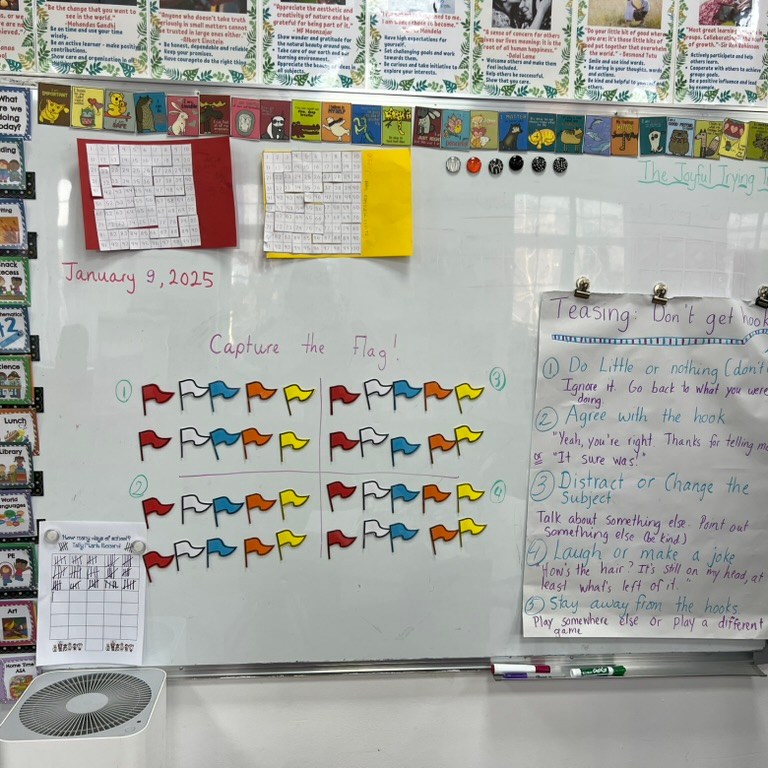
4. Capture the Flag
This is a fun and active game that can be adapted to any subject. To play, print out flags on different colored paper, laminate them, and attach magnetic tape so they can be easily stuck to a whiteboard or projector screen. Divide the class into teams and give each team two flags of each color. Assign a point value to each color flag, but don’t share the point system with the learners. After each question, a group can steal a flag from another team if they answer the question correctly. At the end of the lesson, reveal the point value of each flag and calculate which team has the most points. This game gets learners up and moving around the classroom throughout the lesson.

5. Indoor Snowball Fight
Who says you can’t have a snowball fight indoors? This is a fun and engaging way to practice any subject matter. To play, print out snowballs with different questions related to your topic. You can also include some “yellow snow” cards that require learners to do a short exercise routine. Crumple up the snowballs and toss them around the classroom. Learners pick up a snowball, answer the question on a recording sheet, and then complete any exercises if they get a yellow snow card. This game is sure to get your learners moving and learning! Here is a link to a snowball fight resource I created on Canva that can be adapted to any topic: Indoor Snowball Fight
6. Boom, Clap, Snatch (with a Twist!)
This is a quick, easy, and engaging game that can be used to review virtually any material, from true/false statements to phonics sounds. It adds a physical element that gets learners listening attentively and reacting quickly. Here’s how to play:
- Preparation: Partners sit facing each other. Place a “tented” card (folded in half to stand like a small tent) between them. The card can display a true/false statement, two different phonemes being learned, two vocabulary words, or any other paired items you want learners to distinguish.
- The Rhythm: Establish a rhythm using body percussion. For example:
- “BOOM”: Learners pat their laps.
- “CLAP”: Learners clap their hands.
- You can create various rhythmic patterns, such as “BOOM, CLAP, CLAP,” “BOOM, BOOM, CLAP,” or even more complex sequences. This adds an element of focus and coordination.
- The Cue: After establishing the rhythm, you’ll say a cue related to one of the items on the card. For example:
- If the card has “True” and “False,” you might say, “The capital of France is Paris.”
- If the card has the phonemes /sh/ and /ch/, you might say the word “ship.”
- If the card has two vocabulary words, you could give a definition for one of the words.
- The Snatch: As soon as learners hear the cue, they race to “snatch” (grab) the correct card in front of them. The first learner to grab the correct card wins that round.
This variation of Boom, Clap, Snatch adds a layer of quick thinking and listening comprehension to the physical actions, making it a fun and effective review activity.
7. Quiz, Quiz, Trade
Quiz, Quiz, Trade, a Kagan cooperative learning structure, is another great way to get learners moving and interacting while reviewing material. Here’s how it works: Each learner creates a question or problem related to the topic being studied. For example, when studying place value, learners might write a number in expanded form on a sentence strip and then create a slider to cover one of the addends. Learners then pair up, quiz each other on their questions, and then trade their question strips. They then find a new partner and repeat the process. This allows learners to review the material multiple times with different classmates, reinforcing their understanding and promoting social interaction.
This is a great collection of games to keep your learners active and engaged, even when you’re stuck indoors!
What are your favorite indoor classroom games? Share your ideas and experiences in the comments below! I’d love to hear from you.



 Honor Learners