
From Endings to Beginnings
At the end of last school year, I wrote about some of the traditions I use to close our year together. Afterwards, several people asked me to share some ideas for the beginning of the year. So here it is—a practice that has become a cornerstone of how I build community with my learners: creating a class name and a class promise. Like all good educators, I learn from others. These traditions are something I learned from my friend and former colleague, Ria, who inspired me to make class names and class promise a part of our classroom culture.
The Hummingbird Story
I like to start with a story that has shaped me since childhood. Wangari Maathai, founder of the Greenbelt Movement in Kenya, Nobel Peace Prize laureate, and my neighbor when I was growing up, often told the parable of the hummingbird.
In the story, a forest is on fire. The big animals stand by, helpless and afraid, while the tiny hummingbird flies back and forth, dropping water on the flames one beakful at a time. The hummingbird says, “I am doing the best I can.”
This story inspires us to think about the qualities we want to embody as a class—small but mighty, resilient, and purposeful. Together, we begin to collect adjectives that describe how we want to be.
Choosing Our Class Name
From there, we make a list of animals. Through discussion, debate, and voting, we narrow our choices down until we land on a combination of one adjective and one animal.
Past classes have been The Helpful Hummingbirds and The Joyful Trying Turtles. This year, after much excitement and thoughtful talk, we proudly became The Kind Foxes.
A class name may sound simple, but it gives learners a powerful sense of identity. It’s something that brings us together as a learning community.
Making Our Class Promise
Alongside our name, we also create a class promise. It’s not a list of rules—it’s our shared commitment to how we want to live and learn together. This year’s promise is:
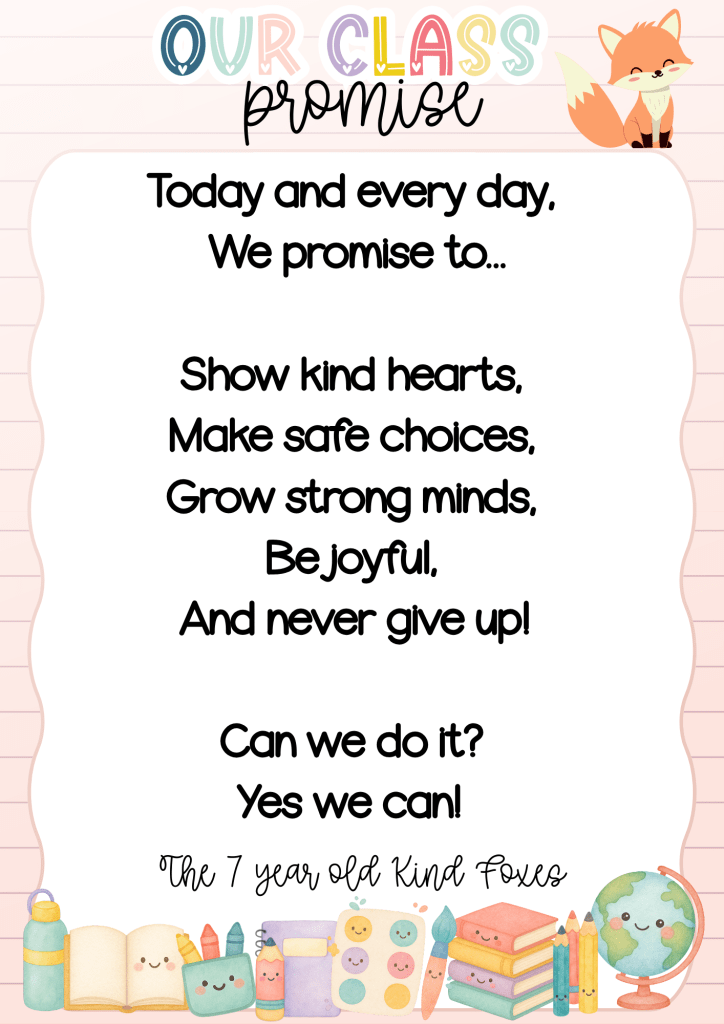
Reciting our promise as a morning chant has become a meaningful ritual. It’s something I first learned during my grade 1 teaching days with Ria, and I’ve carried it with me ever since. Saying it together each day helps anchor our sense of community and it’s a daily reminder for our learners that they helped build the foundation of our classroom community.
Linking to the 4Cs
What I love about this process is how naturally it connects to the 4Cs: Creativity, Collaboration, Communication, and Critical Thinking.
- Creativity – Learners brainstorm fun, meaningful class names.
- Collaboration – Learners work together to refine the promise until it represents everyone.
- Communication – They discuss, debate, and practice explaining their ideas respectfully.
- Critical Thinking – Learners reflect on which behaviors truly matter for making school safe, joyful, and successful.
The result isn’t just words on a wall. It’s a shared agreement that guides our choices and builds trust, day after day.
Why It Matters
When children feel like they belong to something bigger than themselves, they rise to the expectations they’ve helped to create. Our class name and promise become an anchor, shaping not only the way we treat each other but also the way we approach learning challenges together.
And as the year unfolds, I hear students whispering to each other: “Remember, we promised to keep trying.” That’s when I know it’s working.

 Honor Learners